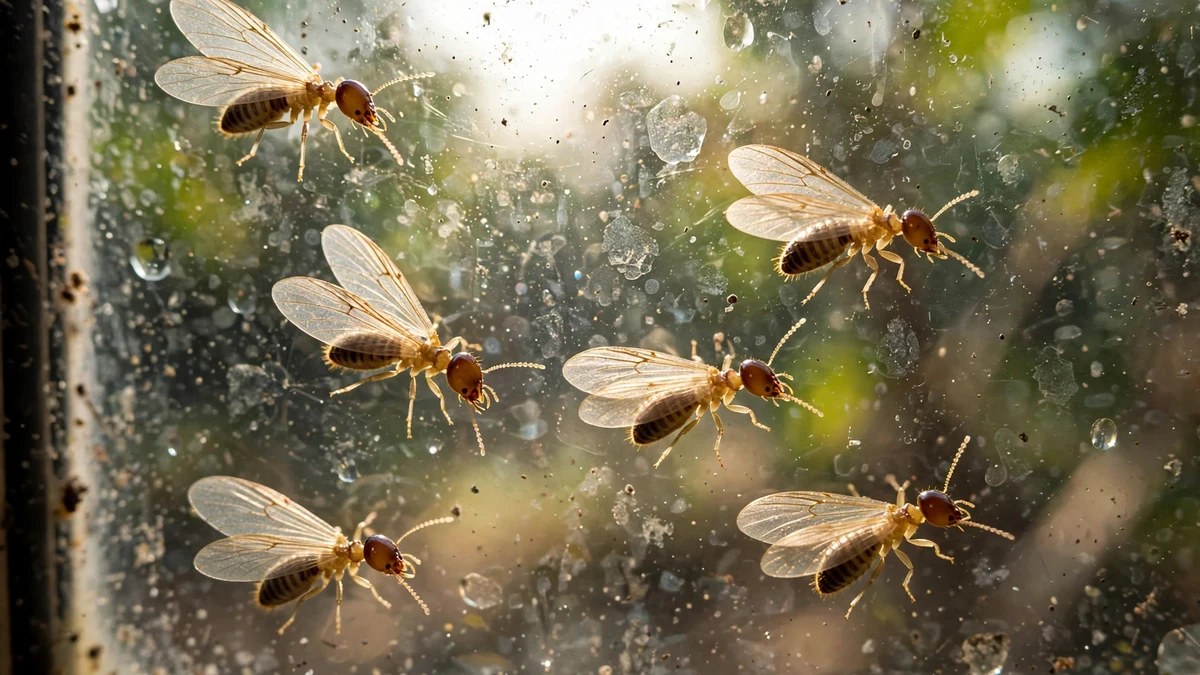
A termite swarm is one of the most alarming things a homeowner can witness: hundreds of winged insects pouring out of a wall, a windowsill, or the soil on a warm afternoon. Here is the reassuring context first — and the important warning second. The swarm itself does no damage; those winged insects are not eating your house. But a swarm means a mature, established colony is nearby, and in Georgia that colony is often inside or directly under the structure. Seeing swarmers is not a reason to panic, but it is a reason to act.
In short: in Georgia, native subterranean termites swarm in daylight from January through early June, Formosans swarm around dusk from mid-May to early June, and drywoods swarm at night in late spring and summer. Any indoor swarm deserves a professional inspection — the swarm ends on its own, but the colony behind it does not.
What Is a Termite Swarm?
A termite swarm is the brief, dramatic flight of winged reproductive termites — called alates — leaving a mature colony to mate and start new colonies. It is a reproductive event, not a feeding event: the swarmers' only job is dispersal, and most die within hours or days whether or not they find a mate.
The critical insight is what a swarm tells you about the colony it came from. A colony must be mature — typically at least several years old, with a large enough worker population to produce reproductives — before it can swarm. So a swarm is not evidence of a new problem; it is evidence of an established one that has been developing, unseen, for years. If the swarmers emerged indoors, from a windowsill, door frame, or wall, the parent colony is very likely in or beneath your home rather than somewhere in the yard.
Swarmers themselves are poor fliers and short-lived. A single swarm event usually lasts from about thirty minutes to a few hours, and a mature colony can produce several swarms across a season — so seeing swarmers twice in one spring does not mean two colonies. After the flight, survivors pair off, shed their wings, and attempt to start new colonies in moist wood or soil contact; the large majority fail. The colony that launched them, meanwhile, loses almost nothing — a few thousand reproductives is a rounding error for a mature colony, which is why the swarm is a signal to act on rather than a problem that solves itself.
When Do Termites Swarm in Georgia?
Because Georgia hosts several termite species with different habits, "swarm season" is really three overlapping calendars. The University of Georgia's entomology guidance and Georgia pest research agree on the general pattern below; exact dates shift a week or two with each year's weather.
Native subterranean termites (Eastern subterranean and relatives): January through early June, during daylight hours. These are the swarms most Georgia homeowners see — often on a warm, sunny afternoon following rain. Notably, native swarmers are not strongly attracted to lights, which helps distinguish them from Formosans.
Formosan termites: mid-May through early June, around dusk — roughly the 8 to 9 p.m. window — and strongly attracted to lights. Formosan swarmers are larger and more caramel-colored than natives, and their swarms can number in the thousands. If your porch lights draw a blizzard of large winged insects on a humid May evening, Formosans are the prime suspect.
Drywood termites: late spring through mid-summer, at night. Drywood swarms are less commonly noticed because they are smaller and nocturnal, and drywood termites are less widespread in North Georgia — but they occur, and their frass (not mud tubes) is the sign to watch for the rest of the year.
How Do Native and Formosan Swarms Differ?
Because the two subterranean species demand different treatment urgency — Formosan colonies are larger and more destructive — telling their swarms apart matters. Use this contrast table:
| Feature | Native subterranean | Formosan |
|---|---|---|
| Season | January–early June | Mid-May–early June |
| Time of day | Daylight | Dusk (~8–9 p.m.) |
| Size and color | Smaller, dark brown to black | Larger, caramel to yellowish-brown |
| Light attraction | Weak — not drawn to lights | Strong — masses gather at lit windows and porch lights |
| Swarm size | Hundreds | Often thousands |
When in doubt, collect a sample (more on that below) rather than guessing from memory — a professional identification takes minutes with the insect in hand and removes all doubt.
What Triggers a Termite Swarm?
Because swarms are synchronized reproductive events, colonies wait for a specific set of conditions before launching. The main triggers are warmth — soil temperatures around 70°F and rising — followed by rain, high humidity, and the low-pressure, calm conditions that typically follow a spring storm. That is why the classic Georgia swarm day is a warm, sunny afternoon right after rain: the colony has moisture, warmth, and still air all at once.
Light conditions matter too, which is why different species swarm at different times of day — each has evolved to launch when its reproductives have the best odds. Barometric pressure drops ahead of storms can also prompt swarms, which is why some homeowners notice swarmers on strangely calm, heavy-feeling afternoons.
Because Georgia's season is so long — January into June — homeowners sometimes assume a March swarm and a May swarm must be different species. Not necessarily: native subterranean colonies swarm repeatedly across their window, and a single colony can produce several flights in one season. What does distinguish species is the combination of timing and behavior: daylight swarms indifferent to your porch lights point to natives; dusk swarms mobbing the lights point to Formosans. When both occur in the same yard in the same spring, you may be looking at two species — which is worth knowing, because Formosan colonies demand a more aggressive treatment response.
Spotted something on this list? Dalton termite treatment starts with a professional inspection — we will tell you plainly what we find and what it takes to fix it.
What Should You Do If You See a Swarm?
Because a swarm looks like an emergency but is not one, the University of Georgia's termite specialists advise homeowners not to panic — and specifically to talk to several pest management firms and read any service contract carefully before signing. Here is the practical sequence we recommend to Dalton homeowners:
1. Note the details. Write down the date, time of day, and exactly where the swarmers emerged — a windowsill, a door frame, the soil near the foundation. Time-of-day and location are diagnostic clues (see the table above).
2. Collect a sample. Trap several swarmers — alive or dead — in a jar or sealed bag. Do not crush them beyond recognition; intact specimens let a professional confirm the species in seconds.
3. Do not spray them. Store-bought repellent sprays kill the visible swarmers but scatter the colony and can make professional treatment harder. The swarmers die on their own within hours anyway.
4. Keep them contained for identification. If swarmers are emerging indoors, do not open the windows to "let them out" — close the room off instead so the evidence stays where the colony is.
5. Call for an inspection. A termite inspection traces the swarm back to its colony and determines the species and extent. From there, treatment options are straightforward — see our termite control in Dalton page for how the process works.
Are Those Termites or Flying Ants?
Because both swarm in spring and look similar at a glance, flying ants are the most common misidentification. The quick test: termite swarmers have straight, beaded antennae, four wings all the same length, and a thick waist with no pinching; flying ants have elbowed antennae, front wings longer than rear wings, and a narrow pinched waist. Termite wings are also glassy and uniform, while ant wings look slightly tinted.
One more clue: termites shed their wings in pale, stacked drifts near windows and lights, while ant wings scatter more randomly. For the full side-by-side comparison with photos of what to look for, see our termites vs. flying ants guide — and if you are seeing the other signs too, our signs of termites in Georgia homes walks through the complete checklist.
What Should You Do After Swarm Season?
Because swarm season is when hidden colonies reveal themselves, the weeks after the last swarm are the ideal time for a professional inspection. Colonies do not disappear when swarming ends — the workers keep feeding all year — so a quiet summer after a spring swarm is not evidence the problem resolved.
Use the post-season window to address the three conducive conditions that invite termites back: cellulose debris (firewood, stumps, and mulch against the foundation), wood-to-soil contact (deck posts, siding near grade), and moisture (leaks, poor drainage, unventilated crawl spaces). If your home has not had a WDO inspection in the past year, schedule one — and if you are preparing for any treatment visit, our home preparation checklist explains what the technician will need to access.
Ready for a straight answer about your home? Dalton termite treatment — call, message, or request a free estimate and we will take it from there.