Call +1 (647) 367-1424 WhatsApp Us Request an Inspection
A termite inspection in Dalton, GA is a professional examination of a structure for wood-destroying organisms - and when a home is changing hands, it produces a specific legal document: the Official Georgia Wood Infestation Inspection Report, the document Georgians call the "termite letter." We are Dalton Pest Pros, and we perform WDO inspections for homebuyers, sellers, and homeowners across Northwest Georgia who need to know, with documentation, what is happening inside their wood.
In short: Georgia does not use the national NPMA-33 form for real-estate transfers. It uses its own state-defined report, issued only by operators certified in the Wood Destroying Organisms category, covering five specific organisms plus conducive conditions - and the report carries a state-attached 90-day re-treatment rule. This page explains the document, the inspection behind it, and when you need one.
What Is a Termite Letter in Georgia?
A Georgia termite letter is the Official Georgia Wood Infestation Inspection Report: a standardized form defined by the Georgia Department of Agriculture's Structural Pest Control Commission, used to report the presence or apparent absence of wood-destroying organisms in a structure. It is a state form, not the NPMA-33 used in many other states, and Georgia's real-estate and lending conventions are built around it. When a Dalton buyer, seller, lender, or closing attorney asks for "the termite letter," this is the document they mean.
The report records two kinds of findings. First, evidence of the five wood-destroying organisms the state requires inspectors to report. Second, conditions conducive to infestation - the environmental factors that invite future problems. The form's language is deliberately careful: a structure with no visible evidence is certified as "apparently free," an honest phrase that reflects what a visual inspection can and cannot prove. Understanding that wording matters, because it shapes what the 90-day rule below actually covers.
Who Is Allowed to Issue a Georgia Termite Letter?
Under Georgia's structural pest control rules, the Official Wood Infestation Inspection Report may only be issued by a pest control operator certified in the Wood Destroying Organisms (WDO) category. This is a verifiable legal fact about the form - not a claim about our company - and it is the single most misunderstood point in Dalton real-estate transactions.
Because the certification requirement is specific, several common substitutes do not count. A general home inspector's note about termites is not a termite letter, even from an excellent inspector - home inspectors are not certified in the WDO category and cannot issue the state form. A contractor's opinion, a previous owner's assurance, or a letter from another state on a different form does not substitute either. Lenders and closing attorneys in Georgia know this distinction, which is why transactions stall when the wrong document shows up at closing. If someone offers you a termite letter, the first question to ask is whether the issuer holds WDO certification - everything else flows from that.
What Does the Inspection Actually Check?
Our WDO inspection is a systematic, visual examination of accessible areas of the structure. Because the state form defines exactly what must be reported, we organize the inspection around its two halves: the organisms and the conditions.
The five wood-destroying organisms
Georgia requires reporting on five organism groups. Knowing the list helps you read your own report:
| Organism | What the inspector looks for |
|---|---|
| Subterranean termites | Mud tubes, damaged wood, swarmers or wings, live activity in soil-contact wood |
| Powder post beetles | Fine powdery frass and small round exit holes in hardwoods |
| Wood boring beetles | Exit holes and frass in structural softwoods and hardwoods |
| Drywood termites | Kick-out holes and six-sided frass pellets; no soil contact needed |
| Wood-decaying fungi | Rot and decay in moisture-damaged wood (molds and mildews are excluded) |
Note the exclusion: ordinary molds and mildews are not wood-destroying organisms under the form, even though moisture that feeds mold also feeds decay fungi. The form is about organisms that destroy wood, and the inspector reports what is visible and accessible at the time of inspection.
Conditions conducive to infestation
The report also documents three conditions conducive to infestation: cellulosic materials (wood debris, stumps, form boards) in contact with or near the structure, untreated wood in direct contact with soil, and inadequate ventilation in the crawl space. These three are worth memorizing, because they are both the most common findings on Dalton inspection reports and the most fixable - and correcting them is the core of our termite control prevention work.
Exterior and crawl space
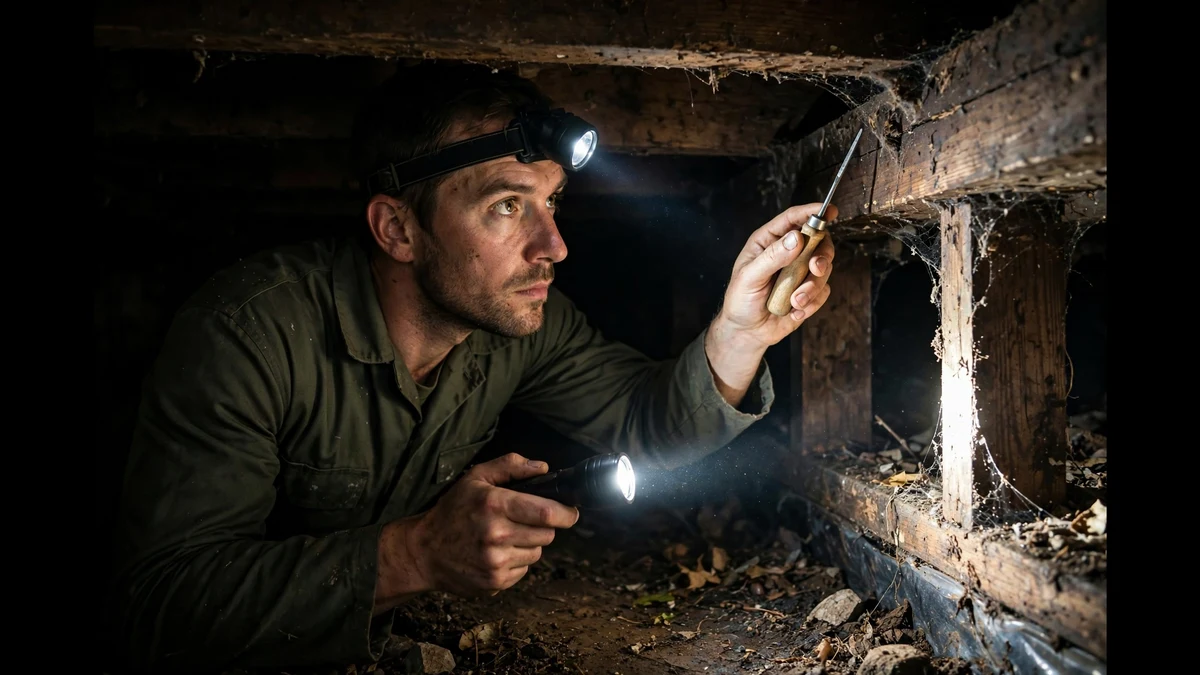
We walk the full exterior perimeter: foundation walls, slab edges, porches, decks, and grading. Then the crawl space, where most Dalton termite evidence lives - piers, sill plates, subflooring, plumbing penetrations, and vapor barrier condition. Crawl spaces are dark, tight, and damp, which is exactly why termites prefer them and why a proper inspection goes in with a bright light and a probe rather than peering from the access door.
Interior and attic
Inside, we check baseboards, window and door frames, bathrooms and laundry areas where plumbing meets wood, and the attic framing. Interior evidence is usually secondary - damage that started at the foundation and worked upward - but finding it changes the treatment plan, so we do not skip it.
What Happens During Our Termite Inspection?
Because termites are the most common wood-destroying organism we find around Dalton, the steps below reflect a termite-focused inspection - though we report all five organism groups on the state form.
- Scheduling and access. We schedule around your closing timeline or your availability. For vacant homes, we coordinate lockbox or agent access - the Supra-key style lockboxes common in our market are routine for us. For occupied homes, we need access to the crawl space entry, attic access, garage, and all rooms.
- Exterior walk. Full perimeter on foot: foundation, grading and drainage, decks and porches, wood-to-soil contact points, and visible mud tubes or damage.
- Crawl space examination. The heart of the inspection. We go under the home with high-output lighting and a probe, checking piers, sills, joists, subflooring, and plumbing penetrations for tubes, damage, frass, and moisture.
- Interior and attic. Room by room at the woodwork, plus attic framing and sheathing for beetle exit holes, drywood frass, and fungal decay.
- Report delivery. Findings go onto the Official Georgia Wood Infestation Inspection Report, which we deliver promptly - because in a real-estate transaction, the closing calendar does not wait.
How Does the 90-Day Guarantee Work?
The 90-day guarantee is a rule attached to the state report form itself - a verifiable fact about Georgia's program, not a marketing promise from our company. Here is what the Georgia Department of Agriculture's rules provide: when a structure is inspected and certified as apparently free of wood-destroying organisms, and an infestation is discovered in that structure within 90 days of the report's issuance, the licensee who issued the report must treat the infestation at no additional charge. The guarantee cannot be waived or altered by agreement - it travels with the form by rule.
A few honest clarifications. First, "apparently free" is doing real work in that sentence: the guarantee covers infestations discovered after a clean report, not damage that was visible and documented on the report itself. Second, the 90-day clock runs from issuance, so timing your inspection sensibly within the transaction matters. Third, this is a re-treatment obligation, not a damage-repair warranty - it gets the infestation treated, which is precisely what a buyer and lender need to know. If you are comparing inspectors, the 90-day rule is identical whoever issues the report; what differs is the thoroughness of the inspection behind it.
When Do You Need a Termite Inspection in Dalton?
Because Georgia sits in the termite belt, the honest answer is "more often than most homeowners think." The four situations below cover nearly every inspection we perform. If your situation does not fit one of these - unusual closing structures, estate sales, new construction - call us; transactions create edge cases regularly.
Buying a home
This is the classic termite-letter scenario. Most Dalton-area purchase contracts and virtually all VA loans require a current WDO report; conventional lenders frequently require one as well. Schedule the inspection early in the due-diligence window so that any findings leave time for treatment and re-inspection before closing - discovering termites the week of closing is how deals get delayed.
Selling a home
Sellers order pre-listing inspections to find problems on their own timeline rather than the buyer's. A clean report in hand strengthens a listing; a report with findings lets you treat and re-inspect before the buyer's inspector finds the same evidence and renegotiates the price.
Annual checkups in the termite belt
Homeowners who are not buying or selling still benefit from annual WDO inspections. Subterranean colonies forage year-round in our climate, and a year is enough time for a new infestation to establish and do real damage silently. Annual inspection is the single cheapest termite protection a homeowner can buy.
After swarm season
Georgia's termite swarm season runs from winter into early summer. If you saw swarmers - or found piles of discarded wings on windowsills - an inspection afterward determines whether that swarm came from your structure or a neighbor's yard. Do not assume the swarmers died and the problem ended; the colony that produced them is still there.
If you are seeing the warning signs yourself first, our signs of termites in Georgia homes guide shows what to look for before you call.
What If the Inspection Finds Termites?
A positive finding is the start of a process, not a disaster - and in the termite belt, it is common enough that every party to a transaction has seen it before. The path forward has three steps. First, treatment: the infestation is eliminated with the appropriate method - liquid soil barrier, bait system, or direct wood treatment depending on species and location - which our Dalton termite treatment page explains in full. Second, re-inspection: after treatment, the structure is re-examined to verify the activity is resolved and to document the outcome. Third, the letter is re-issued: a new Official Georgia Wood Infestation Inspection Report reflecting the current condition goes to the buyer, seller, and lender, and the transaction proceeds. In our experience, most termite findings delay a closing by days, not months - provided the inspection happened early enough to leave room for the work.
WDO Inspections Across Dalton and Surrounding Towns
We perform termite letters and homeowner WDO inspections throughout Dalton and the surrounding Northwest Georgia communities - including Calhoun, Ringgold, and Chatsworth - with our full service area covering the rest. Whether you are up against a closing date or just want to know what is happening under your home, schedule your inspection, call +1 (647) 367-1424, or reach us on WhatsApp. And for the full picture of how we protect Dalton homes from wood-destroying pests, start at our pest control in Dalton, GA home page.