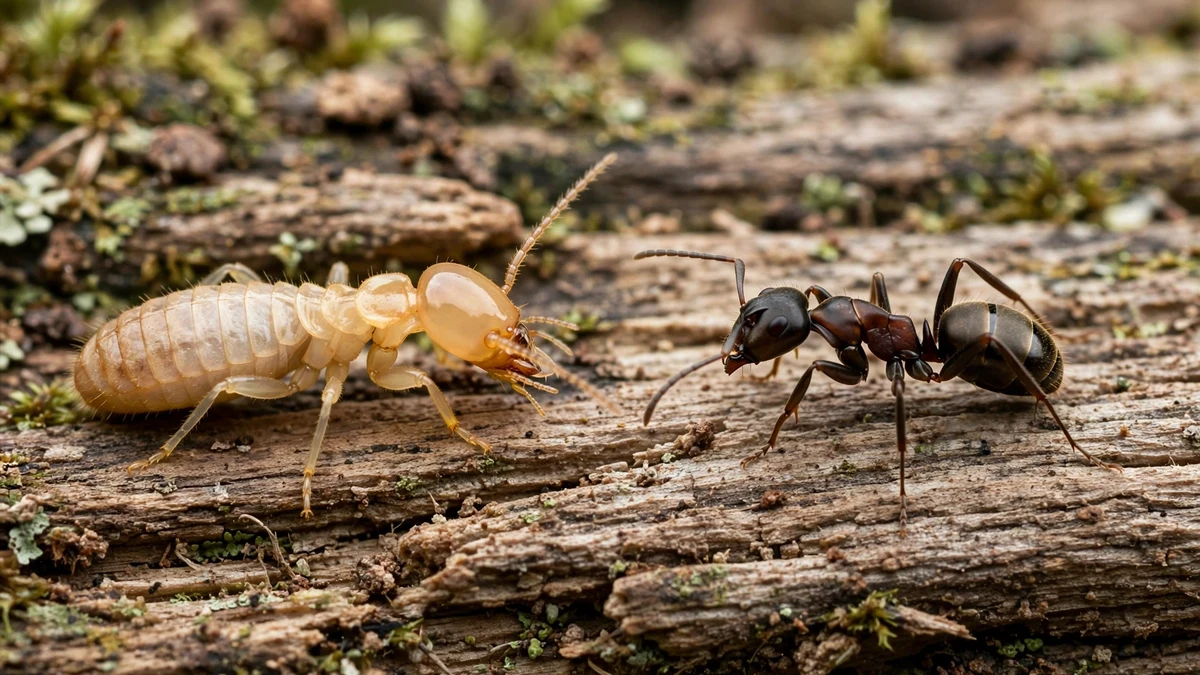
Every spring across Northwest Georgia, the same call comes in: "There are winged bugs all over my windowsill — are they termites?" The confusion is completely understandable. Termite swarmers (alates) and flying ants both appear in warm weather, both are dark-bodied with wings, and both shed those wings shortly after flying. But the consequences of the two could not be more different: termites mean structural damage in progress, while most flying ants mean a colony that is annoying rather than destructive. Getting the identification right determines everything that follows.
In short: check three features — antennae (straight and beaded means termite; elbowed means ant), wings (four equal-length wings means termite; front pair longer means ant), and waist (thick and uniform means termite; pinched means ant). Two out of three pointing the same way is a reliable identification.
Why Do People Confuse Termites and Flying Ants?
Because both insects swarm as part of reproduction, and both do it in spring, homeowners usually encounter them in identical circumstances: a warm afternoon, insects massing at a window or light, and then a drift of discarded wings on the sill. At a glance — and especially in a panicked glance — a half-inch dark winged insect is a half-inch dark winged insect.
The stakes are what make the confusion costly. Misidentify termites as ants and you may spend a season spraying ant killer while a colony keeps eating your framing. Misidentify ants as termites and you may pay for a termite treatment you never needed. Worse, the two require opposite responses: repellent sprays that merely annoy ants can scatter a termite colony and make professional treatment harder. A few minutes of careful identification is the cheapest pest control decision you will ever make.
Up close, the resemblance is genuinely strong. Both are roughly a third to half an inch long, both are dark brown to black, both have two pairs of membranous wings, and both appear in large numbers at windows and lights. Even the shed wings look alike at a glance — translucent, delicate, scattered across the sill. The differences that separate them are small, structural, and consistent: the bend of an antenna, the relative length of wing pairs, the presence or absence of a waist pinch. None of them require expertise to see, only magnification and knowing where to look — which is exactly what the test below gives you.
What Are the 3 Key Differences?
Because entomologists and university extension programs (including Kansas State's extension service, at k-state.edu) teach the same three-feature test everywhere, you can rely on it: antennae, wings, waist. Memorize this table and you will never confuse them again.
| Feature | Termite swarmer | Flying ant |
|---|---|---|
| Antennae | Straight, beaded — like a string of tiny pearls | Elbowed — distinctly bent, like an arm |
| Wings | Four wings, all the same length; extend well past the body; glassy and uniform | Front pair noticeably longer than the rear pair; slightly tinted |
| Waist | Thick and uniform — no narrowing between thorax and abdomen | Pinched — a narrow, wasp-like waist |
| Body | Soft-bodied, uniform width head to tail | Hard-bodied with three clearly distinct segments |
Use a magnifying glass or your phone's macro camera — at arm's length they look identical; at macro distance the differences are obvious. Check at least two of the three features before deciding, since a single damaged specimen can mislead.
Putting the test into practice: start with the waist, because it is visible at the lowest magnification — a pinched, wasp-like waist means ant, full stop, and you can often see it with the naked eye on a cooperative specimen. Next check the wings: lay the insect on white paper and compare the two wing pairs; termite wings extend well past the body and match in length, while ant wings show an obvious long-front, short-rear pairing. Check the antennae last, since they need the most magnification — straight and beaded versus distinctly elbowed. If two of the three agree, you have your answer; if they disagree, the specimen is probably damaged, so test a second insect rather than splitting the difference.
What Do Their Discarded Wings Tell You?
Because both insects shed their wings after swarming, you will often find only the wings — and the wings alone can identify the insect. Termite wings are the giveaway: all four are the same length, glassy-clear, and they tend to pile in pale, stacked drifts near windows, doors, and light fixtures, as if someone emptied a tiny envelope of cellophane.
Ant wings, by contrast, come in two sizes (the front pair longer), look slightly smoky or tinted rather than glassy, and scatter more randomly instead of stacking. If you find a neat drift of uniform, equal-length wings on a Georgia windowsill in spring, you are almost certainly looking at termite evidence — photograph it, save a few in a bag, and read our signs of termites in Georgia homes for what to check next.
When Do They Swarm in Georgia?
Because timing overlaps, the calendar helps but never decides alone. In Georgia, native subterranean termites swarm in daylight from January through early June; Formosans swarm around dusk from mid-May to early June, drawn to lights; drywood termites swarm at night from late spring into mid-summer. Ant swarmers (the reproductive caste of various ant species, including carpenter ants) typically appear on warm, humid days from spring into summer, often after rain — broadly overlapping the termite window.
The timing clue that matters most: winged insects emerging indoors in winter are a strong termite signal. Ant colonies rarely produce indoor winter swarmers, while a termite colony living inside a heated structure can swarm in January. For the full seasonal breakdown, see our termite swarm season in Georgia guide.
Spotted something on this list? Dalton termite treatment starts with a professional inspection — we will tell you plainly what we find and what it takes to fix it.
Can Flying Ants Damage Your Home Too?
Because "ants are harmless" is the usual reassurance, here is the exception every Georgia homeowner should know: carpenter ants also damage wood. Carpenter ants do not eat wood the way termites do — they excavate it to build nests — but the structural result can be just as serious over time, especially in moisture-softened wood around windows, doors, and rooflines.
Their debris gives them away: carpenter ants push coarse sawdust-like frass, often mixed with dead insect parts, out of nest openings. It looks like a tiny sawdust pile, never the uniform six-sided pellets of drywood termites and never the soil-textured mud of subterranean termites. If you find flying ants plus sawdust piles near wood, treat it as a wood-destroying insect problem either way — and see our ant control page for how carpenter ant treatment differs from termite work.
Carpenter ant swarmers also deserve a timing note: they typically appear later in the season than the first termite flights, often on warm humid evenings from late spring into summer, and they are frequently found near the moisture-damaged wood they prefer — window frames with failed seals, roof leaks, damp sill plates. If your winged insects emerge from a specific area of damaged or damp wood rather than from soil or foundation lines, carpenter ants climb higher on the suspect list. Either way, the response is the same: identify carefully, do not spray repellents, and get a professional confirmation before choosing a treatment.
What Should You Do If You've Found Winged Insects?
Because the identification decides the response, work the evidence before you work the problem. Photograph the insects close up — antennae, wings, and waist — and save several intact specimens in a jar or sealed bag. If you found only wings, save those too; as described above, they identify the insect on their own.
Do not spray. Repellent insecticides scatter termite foragers without killing the colony, and they can cause some ant colonies to split (a phenomenon called budding) — making both problems worse. If the insects are termites, or if you cannot tell, the next step is a professional identification and a termite inspection, which traces the swarmers back to the colony. Our termite control in Dalton page explains what happens from inspection through treatment.
What If You Still Can't Tell?
Because misidentification is expensive in both directions, calling for a professional identification is the honest answer when the features are ambiguous — damaged specimens, poor lighting, or wings only. A technician with the insect in hand confirms the species in minutes, and that certainty is worth far more than a confident guess.
Consider the cost of being wrong. Treat ants as termites and you buy a treatment program you never needed. Treat termites as ants and you spend months — sometimes years — fighting the wrong insect while the colony feeds undisturbed, with the repair bill growing the whole time. When the evidence is unclear, a professional ID is the cheapest insurance available: schedule a termite inspection and bring your sample with you.
What the professional visit actually involves is straightforward: the technician confirms the species from your sample or from specimens found on site, then traces the evidence — swarm location, wings, mud tubes, frass — back to the colony or nest. For termites, that means a full structural inspection mapping every sign of activity; for ants, it means locating the nest or nests driving the swarm. Either way you leave with a named pest and a scoped plan instead of a guess — which is precisely the outcome the three-feature test is designed to get you to on your own when the evidence cooperates.
Ready for a straight answer about your home? Dalton termite treatment — call, message, or request a free estimate and we will take it from there.