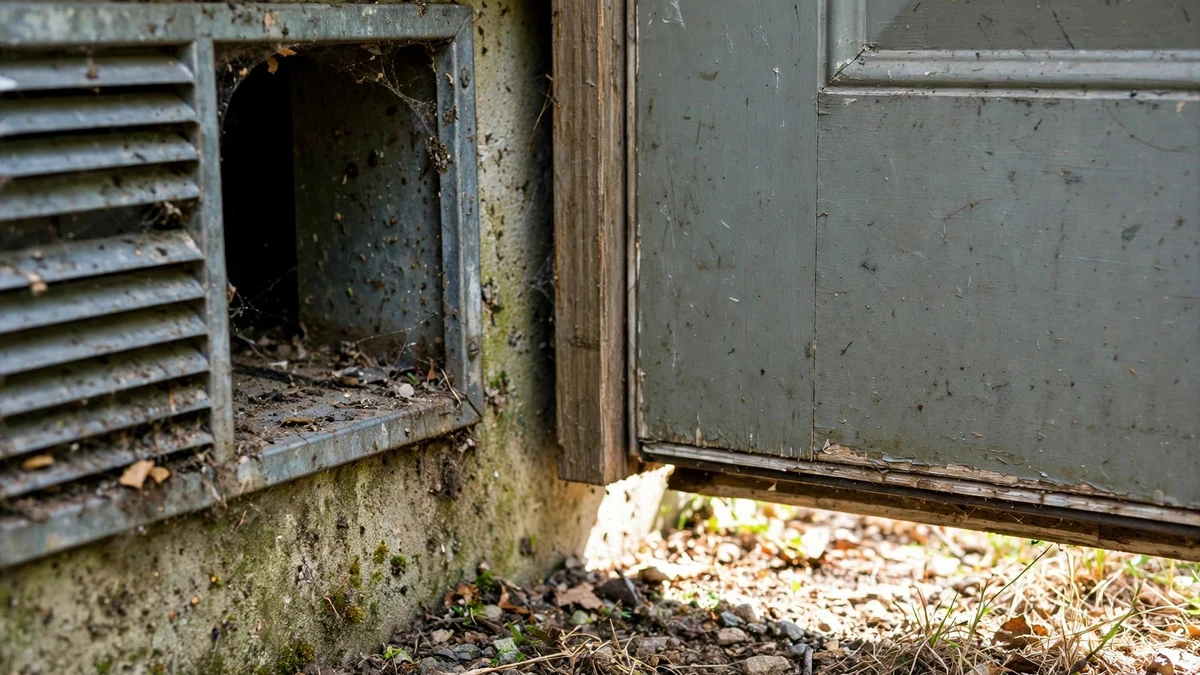
Homeowners usually picture rodents chewing dramatic holes through walls. The reality is quieter and smaller: most mice and rats walk through gaps that were already there — a quarter-inch space under a door, a half-inch gap where a pipe enters the wall, a vent screen with a torn corner. Your house does not need a hole; it needs a gap, and every house has gaps.
In short: a mouse fits through a 1/4-inch gap and a rat through a 1/2-inch gap. The most common entries are utility penetrations, gaps under doors, foundation cracks, and vents. Find them with a slow exterior walk at dusk, seal with copper mesh plus caulk or 1/4-inch hardware cloth — and trap and remove the rodents before you seal, never after.
How Small a Gap Can a Mouse Fit Through?
A house mouse can squeeze through a gap as small as 1/4 inch — roughly the width of a pencil, or the diameter of a dime. A Norway or roof rat needs about 1/2 inch — the width of a quarter. The reason is skeletal: a rodent's skull is the widest rigid part of its body, and if the head fits, the collapsible ribcage follows.
This is why "sealed" homes still get mice. A quarter-inch gap is invisible from across the room. It hides under the lip of a garage door, behind a downspout bracket, in the corner where siding meets foundation. Around Dalton, where many homes sit on crawl spaces with vented foundations and pier-and-beam construction, those quarter-inch opportunities multiply — every vent, every pipe penetration, every aging mortar joint is a candidate. You are not looking for holes. You are looking for shadows that should not be there.
What Are the 9 Most Common Rodent Entry Points?
Because rodents exploit existing gaps rather than creating them, these nine account for the large majority of entries we find in Northwest Georgia homes:
1. Utility penetrations
Where pipes, cables, and conduits pass through exterior walls and foundations, the opening is almost always larger than the pipe. Check where the AC lineset, water line, gas line, and cable entries pass through — a gap the width of a finger around a pipe is a mouse highway.
2. Gaps under exterior doors
Garage doors, basement doors, and side doors that do not seal tight at the bottom. If you can see daylight under a closed door, a mouse can walk under it. Worn weatherstripping and missing door sweeps are the usual culprits.
3. Foundation cracks and mortar gaps
Aging foundations develop cracks; brick and block homes develop mortar gaps. Anything 1/4 inch or wider at or near ground level deserves sealing — and in crawl-space homes, check the foundation vents too, where screens corrode or pull loose.
4. Crawl space vents
Vented crawl spaces — common in Dalton-area construction — are ringed with screened openings. A torn, rusted, or missing vent screen is an open invitation, and vents sit at exactly the height mice prefer to travel.
5. Soffit and roofline gaps
Where the roof meets the walls, construction gaps, rotted fascia, and loose soffit panels give roof rats and climbing mice upper-story access. These are the entries homeowners never check, because they never look up there.
6. Chimneys
An uncapped chimney is a vertical entry shaft. Mice, rats, and squirrels all use them. A proper chimney cap with 1/4-inch mesh closes this route while keeping the flue functional.
7. Basement and crawl-space windows
Old basement windows with rotted frames, missing panes, or gaps around the frame are classic low-level entries — dark, quiet, and rarely inspected.
8. Dryer and exhaust vents
Dryer vents, bathroom exhaust vents, and range-hood vents penetrate the wall with flaps that warp or stick open. The warm air current even advertises the opening. Rigid vent covers with built-in screening solve it.
9. Gaps around windows and doors
Settling, rotted trim, and shrunken caulk open gaps around window and door frames — especially on the shaded, damp side of the house where trim rots first. Probe soft trim with a screwdriver; if it sinks in, the gap behind it is already rodent-accessible.
Do Different Rodents Use Different Entry Routes?
Because the three local species have different habits and climbing abilities, they favor different routes — and the route tells you which species you are dealing with:
| Species | Typical entry routes | Clues |
|---|---|---|
| House mouse | Low gaps: under doors, utility penetrations, foundation cracks, vents | Tiny droppings (rice-grain size), gnaw marks on food packaging, nesting in drawers and appliances |
| Norway rat | Ground level: burrows against foundations, sewer-connected openings, basement windows, gaps under doors | Burrow holes near the foundation, larger droppings, greasy rub marks along baseboards |
| Roof rat | High: rooflines, soffits, chimneys, branches touching the house, overhead utility lines | Noises in the attic or walls at night, droppings in the attic, gnawed wiring insulation |
Hearing scratching overhead at night? That is roof-rat or attic wildlife territory — our attic-noise guide walks through the sound-by-sound identification. Droppings in the pantry point to house mice; burrows along the foundation point to Norway rats.
Spotted something on this list? rodent control in Dalton in Dalton, GA starts with a professional inspection — we will tell you plainly what we find and what it takes to fix it.
How Do You Find Where They're Getting In?
Because you are hunting quarter-inch gaps, the method is a slow, deliberate exterior walk — not a glance from the driveway. Start at dusk or with a bright flashlight: low-angle light makes gaps and shadows visible that midday sun washes out. Walk the full perimeter, crouching at foundation level, and look specifically at every place the nine entry points occur.
Let the signs guide you. Droppings near a wall-floor junction mark a travel route — follow it to its source. Rub marks — dark, greasy smudges where rodent fur oils polish a surface — trace regular runways along pipes and beams straight to the entry. Inside, check the attic and crawl space with a headlamp: look for daylight shining through where it should not, disturbed insulation (nesting), and droppings concentrated in one area.
At night, listen. Scratching and scurrying in walls or ceilings after dark, when the house is quiet, locates active runways. Note the time and location for a few nights — the pattern tells a professional exactly where to focus.
What Should You Seal Holes With?
Because rodents chew, the material matters as much as the sealing. The rule is simple: seal with materials rodents cannot chew through, and use sealant only as the binder, never as the barrier.
| Do use | Do NOT use |
|---|---|
| Copper mesh + caulk: pack copper mesh (won't rust like steel wool) into the gap, then seal over it with exterior caulk — the standard for pipe penetrations | Expanding foam alone: mice and rats chew straight through it; foam is insulation, not exclusion |
| 1/4-inch hardware cloth: galvanized steel mesh for vents, chimney caps, and larger openings | Plastic or vinyl patches: gnawed through in a night |
| Metal door sweeps: brush or rubber sweeps with a metal carrier for gap-under-door problems | Rags, newspaper, or cardboard: nesting material, not barriers |
| Concrete or mortar patch: for foundation cracks and mortar gaps | Caulk alone in large gaps: fine as a finish over mesh, useless as the only barrier |
For sealing around pipes specifically: pack the annular gap with copper mesh first, then tool exterior-grade caulk over it. The mesh is the barrier; the caulk is weatherproofing and finish.
Should You Seal First or Trap First?
Trap and remove first. Seal second. Never the reverse. Because sealing entry points with rodents still inside does not solve the problem — it converts it. Trapped rodents die in wall voids (odor, flies, stains), gnaw new exits through drywall and wiring (fire risk from damaged wiring is real), and become desperate and destructive.
The correct sequence is: identify and monitor entries, trap and remove the interior population until activity stops (no new droppings, no night noises for at least a week), then seal every entry point you found — including the ones that looked inactive. Sealing only the active entries while leaving the quiet ones open just reroutes the next mouse. This trap-first-then-seal order is also why professional rodent control in Dalton is structured as removal plus exclusion, not one or the other.
When Should You Call a Professional?
Because some entries and infestations exceed DIY scope, call when: the entries are on rooflines, second-story soffits, or other places you cannot safely reach and inspect; droppings and activity persist after your trapping and sealing (meaning you missed entries or the population is larger than it looks); rats are involved rather than mice — Norway rats connected to sewers or burrowing under slabs need professional-grade exclusion; or breaches keep recurring, which usually means the entries were misidentified.
Professional exclusion also covers what DIY cannot easily do: a full attic and crawl-space inspection, identification of all three species' distinct routes, and sealing with commercial-grade materials at every point — including the ones on the roof you have never seen. If you are preparing for a visit, our home preparation checklist explains what we will need to access, and if the noises are overhead, start with our attic wildlife guide — or reach out through wildlife removal if the evidence points to squirrels or raccoons rather than rats.
Ready for a straight answer about your home? rodent control in Dalton — call, message, or request a free estimate and we will take it from there.