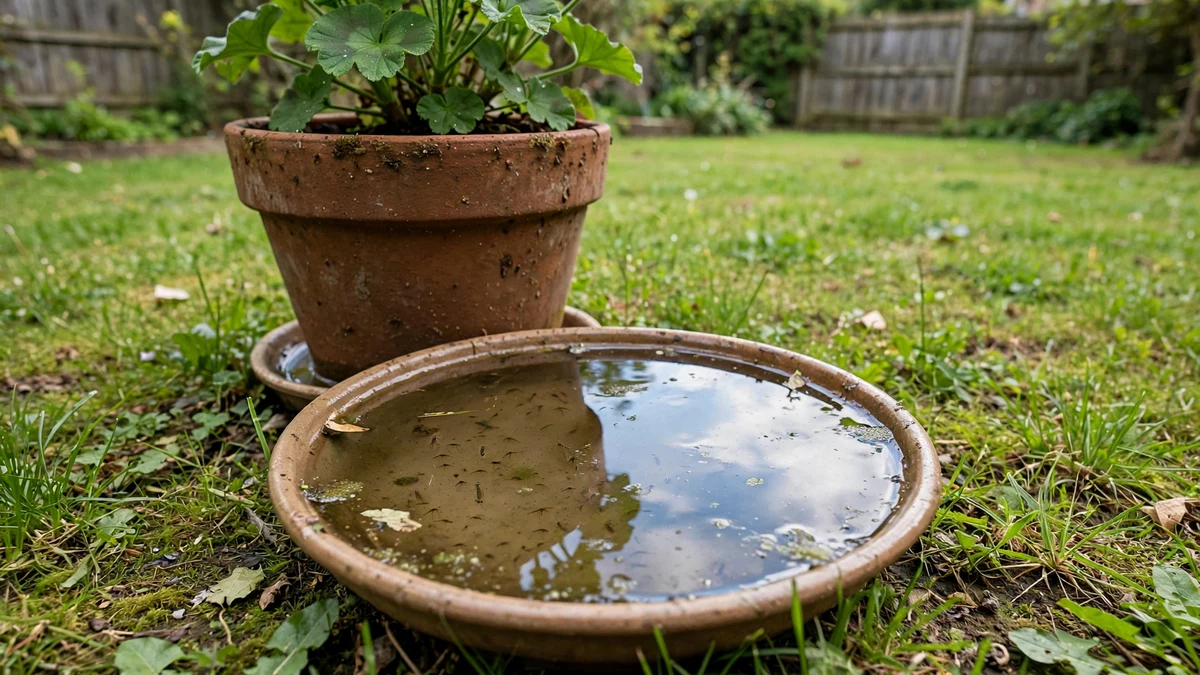
If you have ever wondered why your yard swarms while your neighbor's does not, the answer is almost always water. A female mosquito lays her eggs in standing water, and those eggs become biting adults in about a week in Georgia's summer heat. Remove the water and you break the cycle at its most vulnerable point — before a single bite happens.
In short: mosquito control equals water control. Dump or treat any water that stands more than 3 days, hunt down the hidden sources (gutters, saucers, corrugated downspouts), use BTi dunks for water you cannot drain, and reduce the shady, humid harborage where adults rest. Do all of that consistently and your mosquito pressure drops dramatically.
What Is the #1 Rule of Mosquito Prevention?
Because every other tip on this list is a footnote to it, memorize the principle first: mosquito control is water control. Adult mosquitoes are hard to fight — they fly, they hide, they come back. Larvae are easy to fight: they are trapped in whatever water they hatched in, and they cannot survive without it.
The operational version is the 3-day rule: dump, drain, or treat any standing water at least once a week — and remember that mosquitoes can complete the egg-to-adult cycle in as little as a week in summer heat, so "every couple of weeks" is not enough. Build a weekly tip-and-toss routine: walk the yard once a week, tip every saucer, bucket, toy, and tarp, and you will interrupt more breeding cycles than any single product can.
Where Are Mosquitoes Breeding in Your Yard?
Because the obvious sources (birdbaths, pet bowls) are only half the story, here is the hidden-source catalog we walk Dalton homeowners through — the places breeding actually happens:
- Clogged gutters: the number-one hidden source. A gutter holding an inch of water and leaf sludge is a mosquito nursery running the length of your roofline. Clean them, and make sure they drain.
- Plant saucers: the classic. Dump them weekly or fill with sand so water cannot pool.
- Corrugated downspout extenders: the ridges trap water in every corrugation. Replace with smooth pipe or make sure they drain fully.
- Tarps and grill covers: any sag collects rain. Tighten tarps so water sheets off instead of pooling.
- Kids' toys: buckets, sandboxes with covers that sag, ride-on toys with cup holders — all hold water for days.
- Old tires: the textbook mosquito source. Remove them or drill drainage holes.
- Tree holes and stumps: natural cavities hold rainwater for weeks. Fill with sand or soil.
- Birdbaths: dump and scrub weekly — the scrubbing matters, because eggs stick to the sides above the waterline.
- Pet water bowls: refresh daily; outdoors bowls breed mosquitoes between refills.
- Low spots and puddles: yard areas that hold water for days after rain. Regrade or install drainage for chronic spots.
- AC drip lines and condensate drains: the constant trickle keeps a puddle alive all summer — extend the line to a drain or dry area.
- Wheelbarrows, canoes, and stored boats: anything that holds its shape holds water. Store upside down or covered tight.
- French drains and catch basins: underground drainage that holds standing water breeds mosquitoes invisibly — treat with BTi (below).
What Do You Do About Water You Can't Drain?
Because some water has to stay — birdbaths, ornamental ponds, rain barrels, drainage structures — the answer is BTi (Bacillus thuringiensis israelensis), a naturally occurring bacterium sold as dunks and bits. BTi produces proteins that are lethal to mosquito (and black fly) larvae but essentially nontoxic to everything else.
Drop a dunk into a birdbath, pond, or catch basin and larvae die within about a day of ingesting it; each dunk lasts roughly 30 days. Per the EPA's BTi safety profile, it is considered safe for use around kids, pets, birds, fish, and pollinators when used as labeled — which is why mosquito-control professionals use it in the most sensitive environments. It does not kill adult mosquitoes, so pair it with source removal rather than treating it as a standalone fix. For rain barrels, use a tight screen on the inlet plus BTi inside — the screen keeps adults out, the BTi handles anything that gets through. For granular "bits" formulations, sprinkle directly onto the water surface of drains and saucers you cannot dump; they release the active ingredient faster than dunks, which makes them ideal for quick knockdown of an active larval population you have just discovered.
How Do You Make Your Yard Less Mosquito-Friendly?
Because adult mosquitoes rest in cool, humid, shady vegetation during the heat of the day, the second layer of prevention is making your yard a bad place to hide:
- Mow regularly — tall grass is prime daytime harborage. Keep it short, especially near patios and play areas.
- Trim dense shrubs and low branches to open airflow and let sunlight in; mosquitoes avoid dry, breezy, sunny spots.
- Clear leaf litter from beds and fence lines — damp leaf layers shelter resting adults.
- Restrain the mulch: deep, constantly damp mulch against the house holds humidity. Keep it at a moderate depth and pulled back from foundations.
- Run fans on patios: mosquitoes are weak fliers — a good oscillating fan creates a no-fly zone more effectively than most gadgets.
- Move seating away from dense foliage: the chair tucked into the shrubbery is the chair in the mosquito lounge. Pull entertaining areas into open, breezy space.
Spotted something on this list? mosquito control in Dalton in Dalton, GA starts with a professional inspection — we will tell you plainly what we find and what it takes to fix it.
How Do You Protect Yourself Outdoors?
Because no yard treatment makes you invisible to mosquitoes, personal protection is the third layer. Use EPA-registered repellents — DEET, picaridin, and oil of lemon eucalyptus (OLE) are the active ingredients with the strongest evidence base, per EPA guidance — applied according to the label. Treat clothing (not skin) with permethrin for long-lasting protection on hikes, yard work, and evenings out; one treatment survives multiple washes.
Time your exposure: the mosquitoes that bother Georgians most feed hardest around dusk and dawn, so schedule yard time for midday when you can, and wear long sleeves and pants in the evening. And remember the fan trick from above — on a patio, moving air is the simplest personal protection there is.
A note on permethrin-treated clothing, since it is underused: treating pants, socks, and shoes with permethrin (applied to clothing only, never skin, and allowed to dry fully) gives weeks of protection through multiple washes — it both repels and kills mosquitoes on contact. For anyone who works or exercises in the yard regularly through Georgia's long season, treated clothing plus an EPA-registered skin repellent is the most effective personal-protection combination available without professional help.
What Mosquito "Solutions" Don't Really Work?
Because the mosquito-control aisle is full of confident marketing, here is the honest accounting:
Bug zappers: they kill impressively — mostly moths, beetles, and other beneficial insects. Studies consistently show mosquitoes make up a tiny fraction of zapper kills, because zappers attract by UV light while mosquitoes hunt by CO2 and body heat. A zapper may actually increase bites by drawing mosquitoes toward the area without killing them.
Citronella plants and "mosquito plants": the plants themselves do little; the citronella oil, concentrated and applied, has modest repellent effect. A potted plant on the patio is decoration with a nice story, not control.
Smoke, candles, and torches: provide a small radius of mild relief while burning — fine for ambiance, not a strategy.
Ultrasonic repellers: no credible evidence of effectiveness. Skip them entirely.
The pattern: anything that does not address standing water or create a real barrier is fighting the symptom. That is not to say repellents and fans are useless — they are the honest personal-protection layer — but nothing replaces source reduction.
When Should You Call a Professional?
Because DIY has a ceiling, call when you have done the water work and still cannot use your yard. The honest limits of homeowner effort: neighbor drift — mosquitoes fly in from adjacent properties, and if the abandoned lot or unmaintained pool next door is breeding them, your tip-and-toss cannot keep up; wooded or low-lying lots where natural water cannot be drained; and event-driven need — a wedding, a graduation party — where you need the population knocked down on a deadline.
The professional layer is barrier treatment: targeted applications to the vegetation where adult mosquitoes rest, timed through the season, plus larviciding of sources you cannot eliminate. It does not replace your water work — the best results come from both layers together — but it handles the pressure that source reduction alone cannot reach. Mosquito control in Dalton runs March through October here, and starting early in the season beats playing catch-up in July. Before a visit, our home preparation checklist covers what we will need to access around the yard.
Ready for a straight answer about your home? mosquito control in Dalton — call, message, or request a free estimate and we will take it from there.